|
Merck & Co
crispr Crispr, supplied by Merck & Co, used in various techniques. Bioz Stars score: 86/100, based on 1 PubMed citations. ZERO BIAS - scores, article reviews, protocol conditions and more https://www.bioz.com/product/crispr/crispr+crrna+rna/pm41359388-407-41-45 Average 86 stars, based on 1 article reviews
crispr - by Bioz Stars,
2026-10
86/100 stars
|
Buy from Supplier |
|
Novus Biologicals
anti cas9 Anti Cas9, supplied by Novus Biologicals, used in various techniques. Bioz Stars score: 91/100, based on 1 PubMed citations. ZERO BIAS - scores, article reviews, protocol conditions and more https://www.bioz.com/product/crispr/CRISPR-Cas9+Antibody+(SR1104)/pmc08783129-461-0-6 Average 91 stars, based on 1 article reviews
anti cas9 - by Bioz Stars,
2026-10
91/100 stars
|
Buy from Supplier |
|
Danaher Inc
nucleotide protospacer sequence crrna Nucleotide Protospacer Sequence Crrna, supplied by Danaher Inc, used in various techniques. Bioz Stars score: 95/100, based on 1 PubMed citations. ZERO BIAS - scores, article reviews, protocol conditions and more https://www.bioz.com/product/crispr/Alt-R+CRISPR-Cas9+Negative+Control+crRNA/bio_rxiv__2023__05__05__539557-335-2-6 Average 95 stars, based on 1 article reviews
nucleotide protospacer sequence crrna - by Bioz Stars,
2026-10
95/100 stars
|
Buy from Supplier |
|
Danaher Inc
rhampseq crispr library kit Rhampseq Crispr Library Kit, supplied by Danaher Inc, used in various techniques. Bioz Stars score: 90/100, based on 1 PubMed citations. ZERO BIAS - scores, article reviews, protocol conditions and more https://www.bioz.com/product/crispr/rhAmpSeq+CRISPR+Library+Kit/bio_rxiv__2022__07__12__499808-139-5-9 Average 90 stars, based on 1 article reviews
rhampseq crispr library kit - by Bioz Stars,
2026-10
90/100 stars
|
Buy from Supplier |
|
Danaher Inc
alt r crispr cas9 crrna targeting crebbp exon 26  Alt R Crispr Cas9 Crrna Targeting Crebbp Exon 26, supplied by Danaher Inc, used in various techniques. Bioz Stars score: 95/100, based on 1 PubMed citations. ZERO BIAS - scores, article reviews, protocol conditions and more https://www.bioz.com/product/crispr/CRISPR-Cas9+crRNA/bio_rxiv__2023__02__13__528351-321-11-8 Average 95 stars, based on 1 article reviews
alt r crispr cas9 crrna targeting crebbp exon 26 - by Bioz Stars,
2026-10
95/100 stars
|
Buy from Supplier |
|
Novus Biologicals
nbp2 36440 Nbp2 36440, supplied by Novus Biologicals, used in various techniques. Bioz Stars score: 93/100, based on 1 PubMed citations. ZERO BIAS - scores, article reviews, protocol conditions and more https://www.bioz.com/product/crispr/CRISPR-Cas9+Antibody+(7A9-3A3)+-+N-Terminus+-+BSA+Free/med_rxiv__64898__2026__04__09__26350488-266-16-17 Average 93 stars, based on 1 article reviews
nbp2 36440 - by Bioz Stars,
2026-10
93/100 stars
|
Buy from Supplier |
|
Addgene inc
crrna Crrna, supplied by Addgene inc, used in various techniques. Bioz Stars score: 93/100, based on 1 PubMed citations. ZERO BIAS - scores, article reviews, protocol conditions and more https://www.bioz.com/product/crispr/D%2E+vulgaris+sp2+CRISPR%2FpACYCDuet-1+(Plasmid+%2381186)/pmc10026943-627-16-17 Average 93 stars, based on 1 article reviews
crrna - by Bioz Stars,
2026-10
93/100 stars
|
Buy from Supplier |
|
EpiGentek
anti cas9 Anti Cas9, supplied by EpiGentek, used in various techniques. Bioz Stars score: 93/100, based on 1 PubMed citations. ZERO BIAS - scores, article reviews, protocol conditions and more https://www.bioz.com/product/crispr/CRISPR+Cas9++Monoclonal+Antibody+%5B7A9%5D/pmc10405067-281-33-35 Average 93 stars, based on 1 article reviews
anti cas9 - by Bioz Stars,
2026-10
93/100 stars
|
Buy from Supplier |
|
Cyagen Biosciences
crispr cas9 mediated genome engineering Crispr Cas9 Mediated Genome Engineering, supplied by Cyagen Biosciences, used in various techniques. Bioz Stars score: 96/100, based on 1 PubMed citations. ZERO BIAS - scores, article reviews, protocol conditions and more https://www.bioz.com/product/crispr/CRISPR+mediated+knockout/bio_rxiv__64898__2025__12__04__692469-170-12-15 Average 96 stars, based on 1 article reviews
crispr cas9 mediated genome engineering - by Bioz Stars,
2026-10
96/100 stars
|
Buy from Supplier |
|
Addgene inc
sam sgrna library  Sam Sgrna Library, supplied by Addgene inc, used in various techniques. Bioz Stars score: 93/100, based on 1 PubMed citations. ZERO BIAS - scores, article reviews, protocol conditions and more https://www.bioz.com/product/crispr/Human+CRISPR+Activation+Library+(SAM+-+3+plasmid+system)+(Pooled+Library+%231000000057%2C+%231000000074)/bio_rxiv__435776-187-16-24 Average 93 stars, based on 1 article reviews
sam sgrna library - by Bioz Stars,
2026-10
93/100 stars
|
Buy from Supplier |
|
Addgene inc
tkov3 grna library Tkov3 Grna Library, supplied by Addgene inc, used in various techniques. Bioz Stars score: 94/100, based on 1 PubMed citations. ZERO BIAS - scores, article reviews, protocol conditions and more https://www.bioz.com/product/crispr/Toronto+KnockOut+(TKO)+CRISPR+Library+-+Version+3+(Pooled+Libraries+%2390294%2C+%23125517)/bio_rxiv__2021__05__04__442579-175-2-5 Average 94 stars, based on 1 article reviews
tkov3 grna library - by Bioz Stars,
2026-10
94/100 stars
|
Buy from Supplier |
|
Addgene inc
human improved genome wide knockout crispr library v1 Human Improved Genome Wide Knockout Crispr Library V1, supplied by Addgene inc, used in various techniques. Bioz Stars score: 95/100, based on 1 PubMed citations. ZERO BIAS - scores, article reviews, protocol conditions and more https://www.bioz.com/product/crispr/Human+Improved+Genome-wide+Knockout+CRISPR+Library+(Pooled+Library+%2367989)/pm40135601-37-13-20 Average 95 stars, based on 1 article reviews
human improved genome wide knockout crispr library v1 - by Bioz Stars,
2026-10
95/100 stars
|
Buy from Supplier |
Image Search Results
Journal: bioRxiv
Article Title: Cooperative super-enhancer inactivation caused by heterozygous loss of CREBBP and KMT2D skews B cell fate decisions and yields T cell-depleted lymphomas
doi: 10.1101/2023.02.13.528351
Figure Lengend Snippet: A , Odds ratio (OR) analysis of CREBBP and KMT2D mutations among EZB/Cluster3 DLBCL (n=319) and FL_all (merged FL datasets, n=478) cohorts of patients. The p values were calculated by Fisher’s exact test. B , Representative H&E and B220 IHC images of formalin-fixed paraffin-embedded kidney and liver sections prepared from mice euthanized at day 116 post-BMT. The scale bars represent 380 pixels. C , Representative H&E, B220 and Ki67 IHC images of formalin-fixed paraffin-embedded spleen sections from mice euthanized at day 235 post-BMT. The scale bars represent 200 pixels. D , Representative FACS plots show the gating strategy and frequency of B220 + CD38 - FAS + splenic GC B cells in mice at day 235 post-BMT. E , FACS analysis showing the relative abundance of splenic total B cells (B220 + ) normalized to total single cells at day 116 and 235 post-BMT (mean ± SD). Each dot represents a mouse (n=4 mice per genotype).
Article Snippet: HiFi Cas9 Nuclease (IDT; 1081061), Alt-R CRISPR-Cas9 tracrRNA (
Techniques: Formalin-fixed Paraffin-Embedded
Journal: bioRxiv
Article Title: Cooperative super-enhancer inactivation caused by heterozygous loss of CREBBP and KMT2D skews B cell fate decisions and yields T cell-depleted lymphomas
doi: 10.1101/2023.02.13.528351
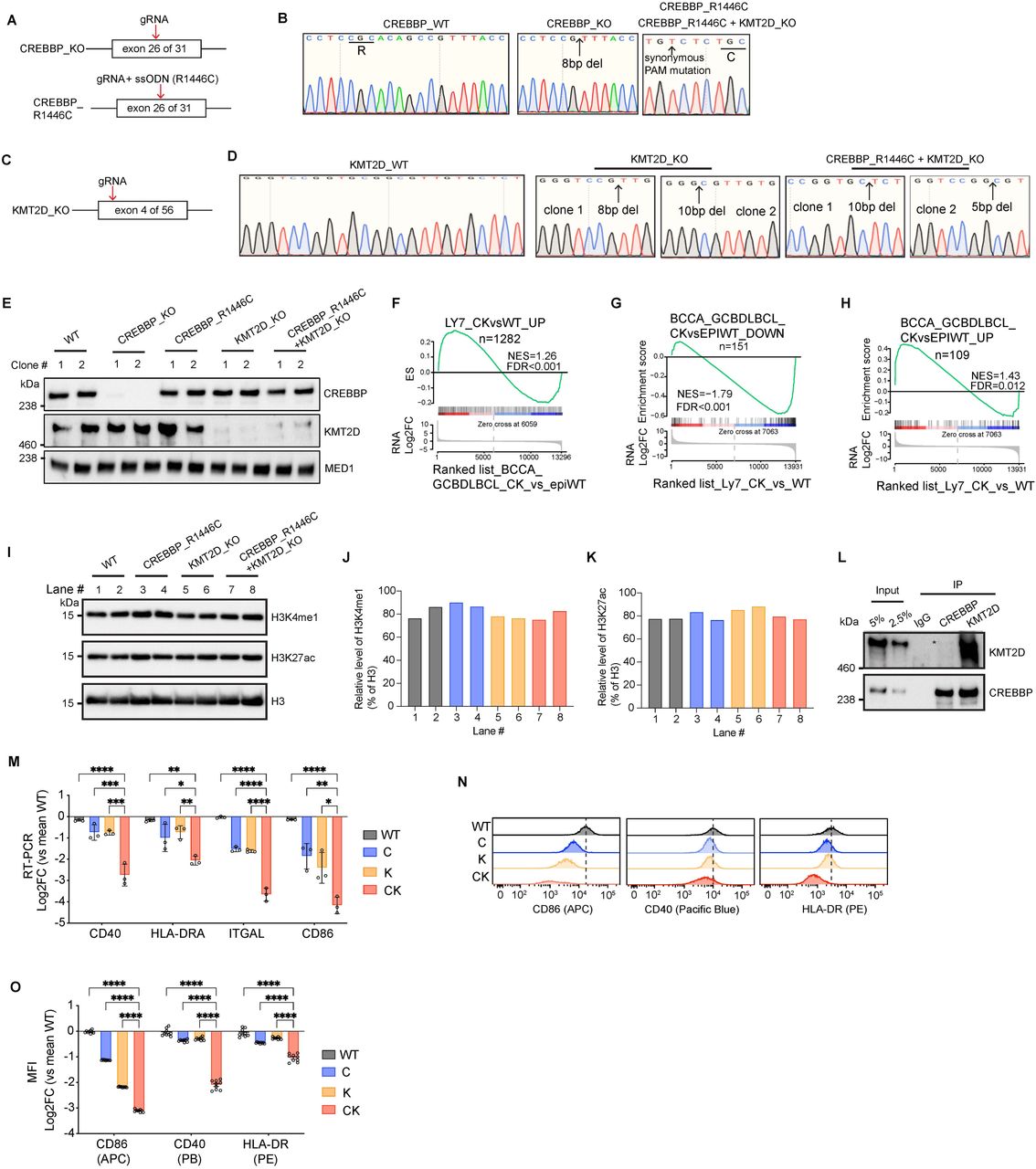
Figure Lengend Snippet: A , Experimental design for generating CREBBP -KO and CREBBP -R1446C, an enzymatically dead mutant, OCI-Ly7 cell lines. ssODN: single-stranded oligodeoxynucleotide. B , Sanger sequencing chromatogram confirming the homozygous knock out or R1446C point mutation in CREBBP . C , Experimental design for generating KMT2D -KO OCI-Ly7 cell line. D , Sanger sequencing chromatogram confirming the homozygous knock out of KMT2D . E , Immunoblotting for endogenous CREBBP and KMT2D in the indicated isogenic OCI-Ly7 cell lines using MED1 as internal loading control. F , GSEA plot using CK vs WT upregulated genes in OCI-Ly7 as the gene set against a ranked gene list based on CK vs epigenetic WT RNA-seq datasets of human BCCA cohort GCB-DLBCL patients. NES, normalized enrichment score. The p value was calculated by an empirical phenotype-based permutation test. The FDR is adjusted for gene set size and multiple hypotheses testing. G-H , GSEA plots using CK vs epigenetic WT ( G ) downregulated or ( H ) upregulated genes in human BCCA cohort GCB-DLBCL patients as the gene set against a ranked gene list based on CK vs WT OCI-Ly7 RNA-seq datasets. NES, normalized enrichment score. The p value was calculated by an empirical phenotype-based permutation test. The FDR is adjusted for gene set size and multiple hypotheses testing. I , Immunoblot for H3K4me1, H3K27ac and H3 in isogenic OCI-Ly7 cells. J-K , Relative densitometry of ( J ) H3K4me1 and ( K ) H3K27ac for panel I . L , Co-IP for assessing interaction between endogenous CREBBP and KMT2D in human SUDHL4 GCB-DLBCL cell line. M , RT-qPCR of indicated genes in different isogenic OCI-Ly7 cells. qPCR signal for each gene was normalized to those of HPRT and then mean WT and presented as log2 fold-change ± SEM. Statistical significance was determined using ordinary one-way ANOVA followed by Tukey-Kramer’s multiple comparisons test (**p < 0.01, ***p < 0.001, ****p < 0.0001). N , Stacked flow cytometry histograms showing the progressive signal decrease for the indicated surface markers in C, K, and CK-deficient OCI-Ly7 cells compared to WT. O , FACS measuring cell surface levels of the indicated markers in different isogenic OCI-Ly7 cells. Mean fluorescence intensity (MFI) of each surface marker was normalized to mean WT and presented as log2 fold-change ± SEM. Each dot represents a biological replicate. Statistical significance was determined using ordinary one-way ANOVA followed by Tukey-Kramer’s multiple comparisons test (****p < 0.0001).
Article Snippet: HiFi Cas9 Nuclease (IDT; 1081061), Alt-R CRISPR-Cas9 tracrRNA (
Techniques: Mutagenesis, Sequencing, Knock-Out, Western Blot, Control, RNA Sequencing, Co-Immunoprecipitation Assay, Quantitative RT-PCR, Flow Cytometry, Fluorescence, Marker
Journal: bioRxiv
Article Title: Cooperative super-enhancer inactivation caused by heterozygous loss of CREBBP and KMT2D skews B cell fate decisions and yields T cell-depleted lymphomas
doi: 10.1101/2023.02.13.528351
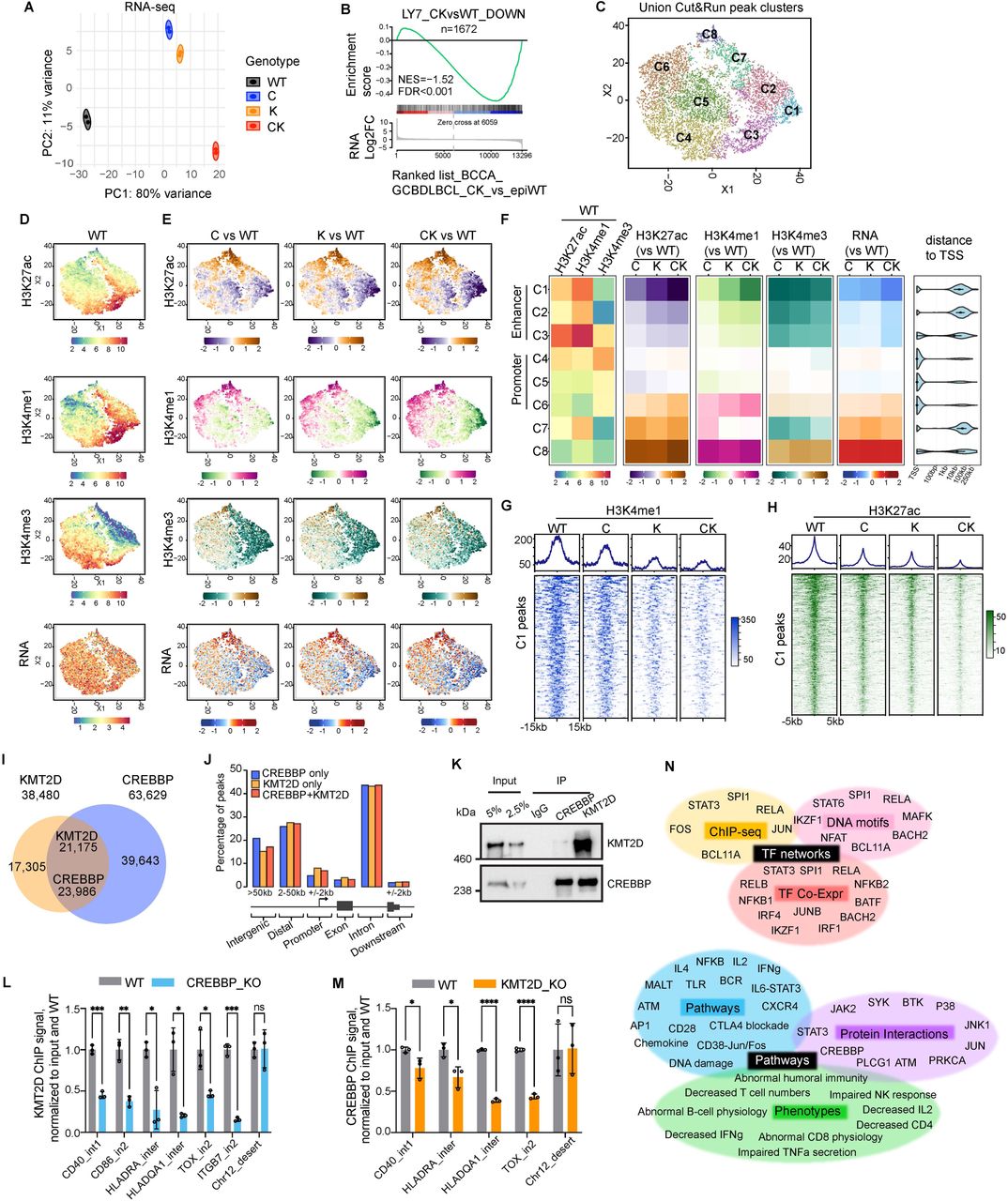
Figure Lengend Snippet: A , PCA analysis of RNA-seq datasets done in isogenic human OCI-Ly7 GCB-DLBCL cell lines (n=2 per genotype) using all genes normalized by VST. B , GSEA plot using CK vs WT downregulated genes in OCI-Ly7 as gene set against ranked gene list based on CK vs epigenetic WT (epiWT, no mutations in CREBBP , KMT2D , and EZH2 ) RNA-seq datasets of human BCCA cohort GCB-DLBCL patients. NES, normalized enrichment score. The p value was calculated by an empirical phenotype-based permutation test. The FDR is adjusted for gene set size and multiple hypotheses testing. C , t-SNE dimensionality reduction and K-means clustering of union peaks, generated by taking the union of H3K4me3, H3K4me1, and K3K27ac CUT&RUN signals from all isogenic OCI-Ly7 cell lines (WT, C, K, and CK), produced eight distinct clusters (named as C1-C8). D , t-SNE plots showing the basal level and distribution pattern of the indicated histone marks or RNA in WT OCI-Ly7 cells. The projected values are VST normalized counts. E , Read density changes for the indicated histone marks and RNA were projected onto t-SNE plots. The projected values are log2FC signal between the indicated genotypes. F , Heatmaps showing median VST normalized read density (left) or read density change (median log2FC) in C/K/CK relative to WT (middle and right) of the indicated histone marks or RNA-seq for each cluster defined in panel C . Distance to TSS plot shows the distance of union peaks to their closest TSSs. G-H , Average signal profiles (top) and heatmaps (bottom) displaying ( G ) H3K4me1 and ( H ) H3K27ac CUT&RUN signals around peak summit (+/-15kb) or peak center (+/-5kb), respectively at C1 peak regions. I , Venn diagram displaying overlap between CREBBP and KMT2D ChIP-seq peaks in OCI-Ly7. J , Genomic feature annotation of CREBBP-unique, KMT2D-unique, and CREBBP/KMT2D-co-bound ChIP-seq peaks. The definitions for different genomic features are depicted below the bar plot. K , Co-IP for assessing interaction between endogenous CREBBP and KMT2D in OCI-Ly7. CREBBP, KMT2D and IgG control were immunoprecipitated from OCI-Ly7 nuclear extracts. Western blots were performed using anti-CREBBP and KMT2D antibodies. L-M , ChIP-qPCR quantifying binding of endogenous ( L ) KMT2D and ( M ) CREBBP at the indicated gene loci in the indicated isogenic OCI-Ly7 cell lines. ChIP signals from three independent experiments were normalized to input and then to WT and presented as mean ± SD. The p values were calculated by unpaired t test and BH adjusted for multiple comparisons and denoted as follows: ns p > 0.05; *p < 0.05; **p < 0.01; ***p < 0.001; ****p < 0.0001. N , Functional annotation of C1 genes (n=401) by Enrichr and Toppgene ( , ).
Article Snippet: HiFi Cas9 Nuclease (IDT; 1081061), Alt-R CRISPR-Cas9 tracrRNA (
Techniques: RNA Sequencing, Generated, Produced, ChIP-sequencing, Co-Immunoprecipitation Assay, Control, Immunoprecipitation, Western Blot, ChIP-qPCR, Binding Assay, Functional Assay
Journal: bioRxiv
Article Title: Heterotypic inter-GPCR ß-arrestin coupling regulates lymphatic endothelial junctional architecture in murine lymph nodes
doi: 10.1101/435776
Figure Lengend Snippet: ( A ) Schematic of S1PR1 modulator screening system Four lentiviral vectors were transduced into U2OS cell line to enable gene activation by SAM and monitoring S1PR1 activation by TANGO system. The cells introduced with SAM sgRNA library were starved with 0.5% charcoal treated FBS, then the Venus-positive population was sorted and next-gen sequence (NGS) analysis was carried out to identify the enriched SAM sgRNA sequences. ( B ) Scatter plot showing enrichment of sgRNAs after sorting. Most sgRNAs are equally distributed in the pre-sort sample (closed gray circles) while after sorting a small fraction of sgRNAs (2,770 out of 70,290 sgRNAs) were enriched and others were not detected (open blue circles). The y-axis shows the NGS reads of sgRNAs. ( C ) Identification of top candidate genes using the MAGeCK method . The names of top ten candidate genes are indicated.
Article Snippet: The single clones were isolated from antibiotics resistant cells by limiting dilution, then introduced with the
Techniques: Activation Assay, Sequencing